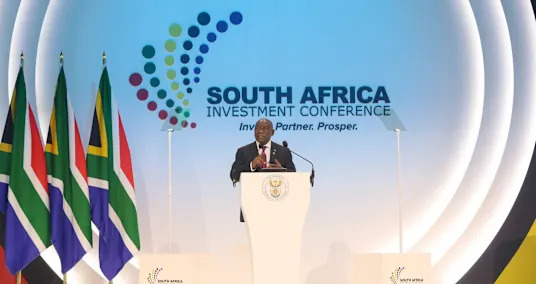
South African President Cyril Ramaphosa launched a nearly $200 billion investment drive aimed at accelerating economic recovery and industrialization in the face of growing worry over the impact of the Iran war on the continent’s biggest economy.
For more than a decade, South Africa’s economy has barely grown, leaving it with crumbling infrastructure and the need to create jobs in a country where one in three people are unemployed. Ramaphosa’s pitch to investors in Johannesburg this week was that South Africa has fixed the worst bottlenecks: He said the country is opening key sectors to private capital and is ready for large scale investments.
Ramaphosa said the effort will run through 2030 with delegates at the South African Investment Conference pledging $53 billion across 31 projects spanning energy, logistics, manufacturing, and digital infrastructure. They include Coca-Cola’s $1 billion expansion plan, and a $3.6 billion commitment from Sasol — the world’s biggest maker of fuel from coal — to upgrade operations.
LATEST POSTS
- 1
 Which game do you cherish observing live? Vote!
 - 2Portugal among EU countries with the most people working close to 50 hours a week
- 3Fuel Price Spike Drives Surge in Used EV Sales in Europe
- 4Rights groups condemn Israel Police decision to ban Sudan Genocide protests nationwide
- 5The most effective method to Explore Moral Situations in Brain research with Your Certification





- The most effective method to Move toward Compensation Conversations for Cutting edge Practice Enrolled Attendants
- Nature carves colossal snowman in Siberia | Space photo of the day for Jan. 2, 2026
- Amateur's Manual for Venture Strategies for Tenderfoots
- Figure out How to Recognize Early Indications of Depressions
- People with depression can treat themselves at home with new device
- Why home maintenance deserves a spot in the annual health and budget plans
- The Solution to Individual budget: Dominating Cash The board
- 2026 will be the year NASA astronauts fly around the moon again — if all goes to plan
- Ads promising cosmetic surgery patients a ‘dream body’ with minimal risk get little scrutiny